RQ4: When all predictors are considered together, which variables contribute the most to predicting affordability?
Approach
RQ4 asks which variables contribute most when predictors are considered jointly. We evaluate two feature sets:
Full:
median_income + cost_yr + {region_name, geotype, race_eth_name}NoCost:
median_income + {region_name, geotype, race_eth_name}
We fit several model families using a fixed train/test split and select the best-performing model within each feature set. To quantify each variable’s contribution, we use permutation importance on the held-out test set.
Note: If cost_yr is mechanically related to how affordability_ratio is constructed, it may dominate importance and inflate performance in the Full setting. The NoCost setting helps isolate how much predictive signal remains in income + contextual variables alone.
import numpy as np
import pandas as pd
from pathlib import Path
import matplotlib.pyplot as plt

from sklearn.model_selection import train_test_split
from sklearn.pipeline import Pipeline
from sklearn.dummy import DummyRegressor
from sklearn.linear_model import LinearRegression
from sklearn.ensemble import RandomForestRegressor, HistGradientBoostingRegressor
from sklearn.metrics import mean_absolute_error, r2_score
from sklearn.inspection import permutation_importance
from utils.model_utils import rmse, make_ohe, split_cols, make_preprocessor, wrap_log1p, eval_model_rq4, pick_best

RANDOM_STATE = 159
np.random.seed(RANDOM_STATE)

DATA_PATH = Path("./data/food_affordability.csv")
OUT_DIR = Path("./outputs"); OUT_DIR.mkdir(exist_ok=True)
FIG_DIR = Path("./figures"); FIG_DIR.mkdir(exist_ok=True)

TARGET = "affordability_ratio"
df = pd.read_csv(DATA_PATH)
# Define feature sets
CONTEXT_FEATURES = ["region_name", "geotype", "race_eth_name"]
FULL_FEATURES = ["median_income", "cost_yr"] + CONTEXT_FEATURES
NOCOST_FEATURES = ["median_income"] + CONTEXT_FEATURES
ALL_USED = sorted(set([TARGET] + FULL_FEATURES + NOCOST_FEATURES))
df_m = df.dropna(subset=ALL_USED).copy()
print("Rows kept:", df_m.shape[0])
df_m[ALL_USED].head()Rows kept: 3473
X_all = df_m[sorted(set(FULL_FEATURES + NOCOST_FEATURES))].copy()
y = df_m[TARGET].copy()

idx = np.arange(len(df_m))
idx_train, idx_test = train_test_split(idx, test_size=0.2, random_state=RANDOM_STATE)

X_train_all, X_test_all = X_all.iloc[idx_train], X_all.iloc[idx_test]
y_train, y_test = y.iloc[idx_train], y.iloc[idx_test]

X_train_all.shape, X_test_all.shape
((2778, 5), (695, 5))feature_sets = {
"RQ4-Full (income+cost+context)": FULL_FEATURES,
"RQ4-NoCost (income+context)": NOCOST_FEATURES
}
rows = []
best_models = {}
all_preds = {}
for fs_name, feats in feature_sets.items():
Xtr = X_train_all[feats]
Xte = X_test_all[feats]
# Baseline
dummy = DummyRegressor(strategy="mean")
dummy.fit(Xtr, y_train)
pred_dummy = dummy.predict(Xte)
rows.append({
"feature_set": fs_name,
"model": "Dummy(mean)",
"RMSE": rmse(y_test, pred_dummy),
"MAE": float(mean_absolute_error(y_test, pred_dummy)),
"R2": float(r2_score(y_test, pred_dummy))
})
all_preds[(fs_name, "Dummy(mean)")] = pred_dummy
# Linear (good baseline)
pre_lin = make_preprocessor(feats, X_train_all, dense=False, scale_num_for_linear=True)
lin = wrap_log1p(Pipeline([("pre", pre_lin), ("lin", LinearRegression())]))
m_lin, pred_lin = eval_model_rq4(lin, Xtr, Xte, y_train, y_test)
rows.append({"feature_set": fs_name, "model": "Linear(log1p y)", **m_lin})
all_preds[(fs_name, "Linear(log1p y)")] = pred_lin
# Random Forest
pre_tree = make_preprocessor(feats, X_train_all, dense=False, scale_num_for_linear=False)
rf = RandomForestRegressor(
n_estimators=300,
random_state=RANDOM_STATE,
n_jobs=-1,
min_samples_leaf=2
)
rf_m = wrap_log1p(Pipeline([("pre", pre_tree), ("rf", rf)]))
m_rf, pred_rf = eval_model_rq4(rf_m, Xtr, Xte, y_train, y_test)
rows.append({"feature_set": fs_name, "model": "RandomForest(log1p y)", **m_rf})
all_preds[(fs_name, "RandomForest(log1p y)")] = pred_rf
pre_hgb = make_preprocessor(feats, X_train_all, dense=True, scale_num_for_linear=False)
hgb = HistGradientBoostingRegressor(
random_state=RANDOM_STATE,
max_depth=6,
learning_rate=0.05,
max_iter=400
)
hgb_m = wrap_log1p(Pipeline([("pre", pre_hgb), ("hgb", hgb)]))
m_hgb, pred_hgb = eval_model_rq4(hgb_m, Xtr, Xte, y_train, y_test)
rows.append({"feature_set": fs_name, "model": "HistGB(log1p y)", **m_hgb})
all_preds[(fs_name, "HistGB(log1p y)")] = pred_hgb
metrics_rq4 = pd.DataFrame(rows).sort_values(["feature_set", "RMSE"])
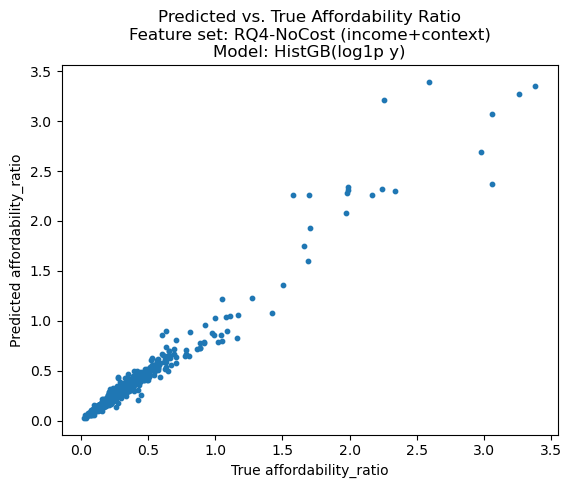
metrics_rq4Tree-based models strongly outperform the linear baseline. With the Full feature set, Random Forest achieves near-perfect performance (R² ≈ 0.996; RMSE ≈ 0.024), while without cost_yr, the best model (HistGradientBoosting) still performs very well (R² ≈ 0.954; RMSE ≈ 0.085). The linear model remains around R² ≈ 0.26–0.27, indicating that nonlinear models capture structure that linear regression does not.
Note: Because cost_yr may be mechanically related to affordability_ratio (depending on how the affordability ratio was constructed), the extremely high R² in the Full setting should be interpreted cautiously as potentially reflecting a definitional/structural relationship rather than purely “discovering” new predictive patterns.
# Save metrics
metrics_rq4.to_csv(OUT_DIR / "rq4_model_metrics.csv", index=False)
for fs_name, feats in feature_sets.items():
best_model_name = pick_best(metrics_rq4, fs_name)
preds = all_preds[(fs_name, best_model_name)]
# Rebuild and refit the best model (so we can run permutation importance cleanly)
Xtr = X_train_all[feats]
Xte = X_test_all[feats]
if best_model_name.startswith("Linear"):
pre = make_preprocessor(feats, X_train_all, dense=False, scale_num_for_linear=True)
best = wrap_log1p(Pipeline([("pre", pre), ("lin", LinearRegression())]))
elif best_model_name.startswith("RandomForest"):
pre = make_preprocessor(feats, X_train_all, dense=False, scale_num_for_linear=False)
best = wrap_log1p(Pipeline([("pre", pre), ("rf", RandomForestRegressor(
n_estimators=300, random_state=RANDOM_STATE, n_jobs=-1, min_samples_leaf=2
))]))
elif best_model_name.startswith("HistGB"):
pre = make_preprocessor(feats, X_train_all, dense=True, scale_num_for_linear=False)
best = wrap_log1p(Pipeline([("pre", pre), ("hgb", HistGradientBoostingRegressor(
random_state=RANDOM_STATE, max_depth=6, learning_rate=0.05, max_iter=400
))]))
else:
continue
best.fit(Xtr, y_train)
# Pred vs True
plt.figure()
plt.scatter(y_test, preds, s=10)
plt.xlabel("True affordability_ratio")
plt.ylabel("Predicted affordability_ratio")
plt.title(
f"Predicted vs. True Affordability Ratio\n"
f"Feature set: {fs_name}\n"
f"Model: {best_model_name}"
)
fig_path = FIG_DIR / f"rq4_pred_vs_true__{fs_name.split()[0].lower()}__{best_model_name.split('(')[0].lower()}.png"
plt.savefig(fig_path, dpi=150, bbox_inches="tight")
plt.show()
# Permutation importance on RAW features (region/geotype/race/income/cost)
imp = permutation_importance(
best,
Xte,
y_test,
n_repeats=20,
random_state=RANDOM_STATE,
n_jobs=-1,
scoring="r2"
)
imp_df = pd.DataFrame({
"feature": Xte.columns,
"importance_mean": imp.importances_mean,
"importance_std": imp.importances_std,
}).sort_values("importance_mean", ascending=False)
print("\n=== Permutation importance:", fs_name, "|", best_model_name, "===\n")
display(imp_df)
# Save + plot
out_csv = OUT_DIR / f"rq4_perm_importance__{fs_name.split()[0].lower()}__{best_model_name.split('(')[0].lower()}.csv"
imp_df.to_csv(out_csv, index=False)
plt.figure()
plt.barh(imp_df["feature"][::-1], imp_df["importance_mean"][::-1])
plt.xlabel("Permutation importance (mean drop in R²)")
plt.title(
f"Permutation Importance\n"
f"Feature set: {fs_name}\n"
f"Model: {best_model_name}"
)
out_fig = FIG_DIR / f"rq4_perm_importance__{fs_name.split()[0].lower()}__{best_model_name.split('(')[0].lower()}.png"
plt.savefig(out_fig, dpi=150, bbox_inches="tight")
plt.show()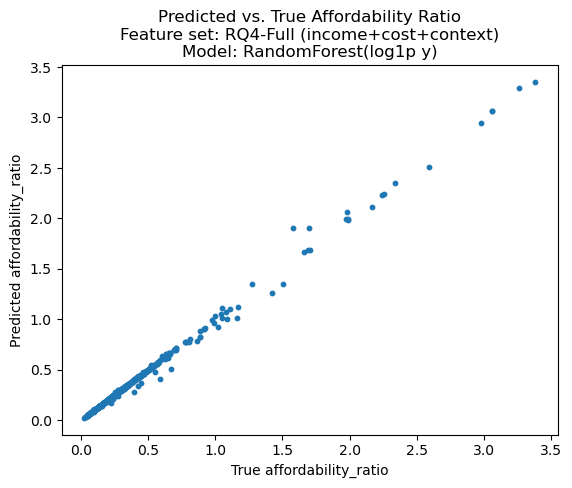
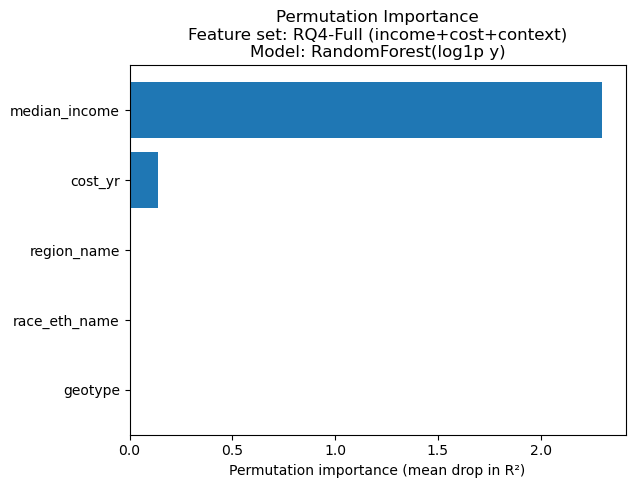
=== Permutation importance: RQ4-Full (income+cost+context) | RandomForest(log1p y) ===
=== Permutation importance: RQ4-NoCost (income+context) | HistGB(log1p y) ===
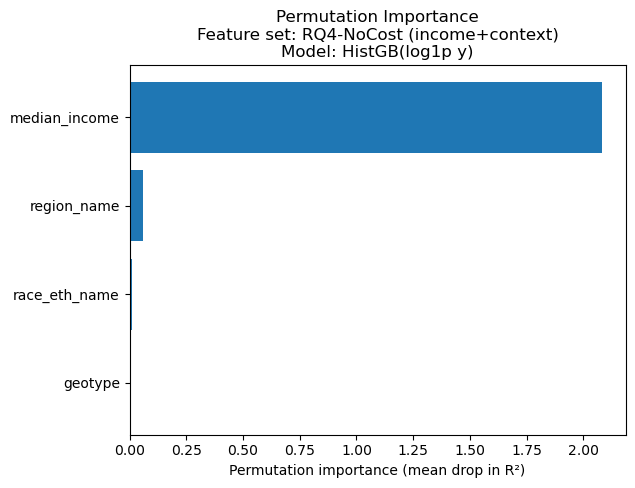
Permutation importance (measured as mean drop in test R² when a feature is permuted) shows that median_income dominates in both settings.
In the Full model,
median_incomeis by far the largest driver, withcost_yras a distant second;region_name,race_eth_name, andgeotypecontribute negligibly.In the NoCost model,
median_incomeremains dominant;region_namebecomes the next most informative feature, whilerace_eth_nameis small andgeotypeis near zero.
Overall, when all predictors are considered together, income is the primary driver, and cost (when included) adds additional predictive power, while geographic/race context variables contribute comparatively little in this dataset/modeling setup.